When architectural blueprints are finalised for major public infrastructure projects, spatial elegance and aesthetic detailing often capture the focus.
However, building safety is inherently incomplete without a robust, code-compliant emergency egress strategy.
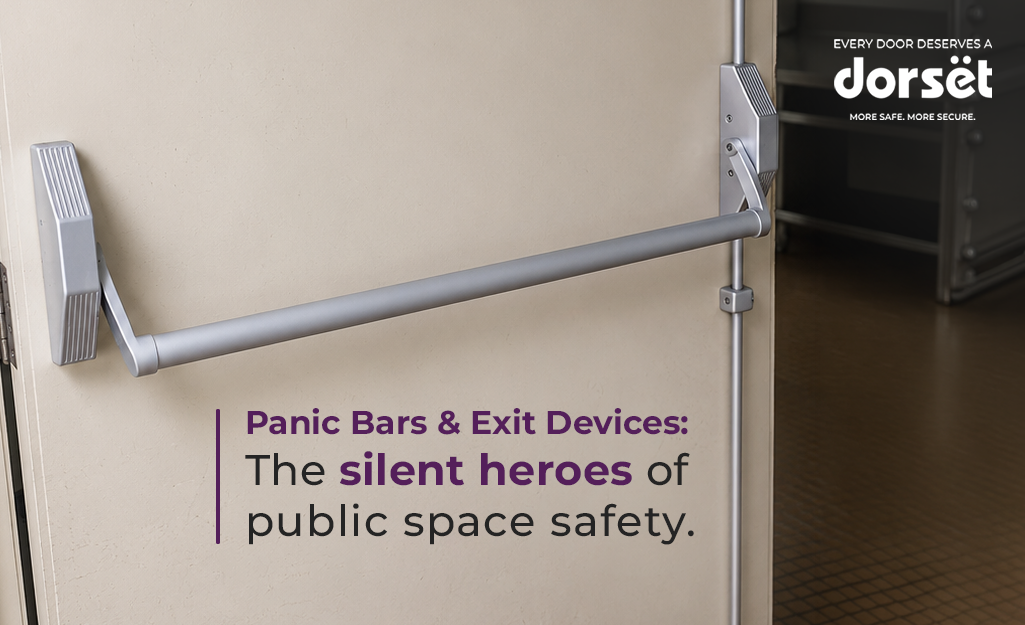
During a sudden crisis the doors along an escape route must transition into seamless exit paths. In this high-stakes environment, premium panic bars & exit devices serve as the vital line of defense, staying out of sight during daily traffic but performing with absolute precision when rapid evacuation becomes necessary.
Why Certified Panic Hardware is Vital for Commercial Space Safety
During an unexpected building emergency, the onset of confusion can cause crowds to move aggressively toward the nearest visible exit point. In these critical moments, a standard pull handle or a traditional lever setup can easily bind or jam under heavy downward or outward force, trapping people inside. Dorset commercial exit devices are purposefully engineered to allow instant, tool-free opening under heavy pressure and heat.
Depending on the unique structural needs of your layout, Dorset offers precise configurations designed for total safety protection:
- Single Point Locking
- Two Point Locking
- Three Point Locking
- External Trim
The Coordinated Role of Fire-Rated Closers
An emergency exit door can only do its job effectively if it closes and latches completely after being used. If a doorway is left propped open by fleeing occupants, it completely compromises the passive fire protection strategy of the building. This makes pairing your exit devices for emergency doors with a premium, certified self-closing device an absolute necessity.
At Dorset, we provide highly dependable door closers tested and certified to maintain absolute containment in extreme heat for up to 120 minutes. These mechanisms makes sure that doors remain fully closed to trap fire and smoke, buy crucial time for occupant evacuation, and reduce overall structural damage across the property.
To support different commercial architectural configurations, our specialized door control units deliver consistent performance across thousands of operational cycles:
Dorset DC 80 Ext (WP) Door Closer
For heavy commercial partitions, wooden fire-rated door assemblies, or metal escape corridors, our heavy-duty models like the Dorset DC 80 Ext (WP) Door Closer provide exceptional fluid-driven resistance. These devices manage the heavy swinging weight of fire-rated doors smoothly, ensuring the door returns safely to a closed position without human intervention.
Dorset DC 65 CO Door Closer
If your project requires advanced engineering that minimizes the opening effort while maintaining high latching force, our specialized cam-action models like the Dorset DC 65 CO Door Closer deliver an ideal solution. Equipped with advanced technology and a power adjuster, it allows facility teams to adapt closing performance under demanding conditions like heavy wind or hallway draft pressure.
Selecting the Right Hardware for Code-Compliant Openings
Integrating high-performance emergency exit hardware requires a deep understanding of building rules, door composition, and anticipated human traffic. When selecting components for your safety pathways, building inspectors look for certified safety assurance from recognized international testing bodies.
When planning your layout, avoid relying on individual, unrated parts and focus on complete door safety solutions by checking these core installation guidelines:
- Assess the Door Weight and Traffic: Lightweight internal doors and grand, heavy exit doors require distinct closing strengths. Dorset provides models tailored to match diverse weights, comfortably controlling panels up to 120 kg.
- Evaluate Fire Resistance Needs: Always match your hardware selection to the required fire-exposure rating of your building zone, whether your project calls for up to 120 minutes of total containment.
- Maintain Tight Compatibility: Make sure that the underlying door leaf, structural frame, hinges, panic bar latching tracks, and overhead closer arms match each other perfectly to avoid premature mechanical friction or dropping over time.
Preserving Long-Term Life Safety Performance
Public infrastructure hardware encounters constant physical stress and high-frequency use day after day. To keep your integrated door safety solutions functioning optimally for years to come, commercial facility managers must conduct regular maintenance - learn why door closers are mandatory for commercial safety compliance to understand what's at stake.
- Inspect Latching Force: Verify that seasonal temperature changes have not altered the fluid dynamics inside your hydraulic systems, ensuring the door closer still delivers enough force to snap the latch completely into the strike plate.
- Test the Escape Bar: Conduct routine pressure tests on the horizontal bar to secure the panic bar door hardware instantly releases the locking mechanism without any mechanical sticking or dragging.
- Audit Egress Pathways: Confirm that no temporary obstacles, security chains, or unauthorized blocks interfere with the outward swing of your exit devices for emergency doors.
Total Engineering for Absolute Peace of Mind
True building compliance is achieved when high-quality structural components operate seamlessly together under extreme environmental strain. By combining Dorset's highly responsive panic bars & exit devices with our proven fire-rated door control series, you invest in a unified system designed to protect occupants when it matters most. Choose certified, world-class Dorset architectural hardware to build public spaces that are deeply reliable, thoroughly compliant, and genuinely safer for the communities who walk through them every day.
FAQs
1. How do Panic Bars & Exit Devices improve life safety compared to regular locks?
Ans. Standard locks require precise hand actions like turning a knob or twisting a key, which can jam if a crowd presses against the door leaf during a rush. Premium Panic Bars & Exit Devices remove this danger completely; any simple physical contact or downward push anywhere along the horizontal bar releases the mechanism instantly for immediate escape.
2. Can I install a Dorset panic bar door hardware system on any exit door?
Ans. Yes, our specialized panic bar door hardware is designed to work across diverse architectural configurations. Whether you are installing it on wooden partitions, steel fire-shielded frames, or glass entrance panels, Dorset provides specialized single, two-point, and three-point vertical locking lines to match your structural layout.
3. Why must commercial exit devices always be paired with a fire-rated door closer?
Ans. An open fire door cannot block a hazard. While commercial exit devices ensure that people can escape instantly, an active fire closer makes sure the door swings fully shut right behind them. This vital coordination blocks toxic smoke and oxygen from traveling into escape paths, preserving the integrity of your emergency routes.
4. Which international safety standards do Dorset exit devices for emergency doors meet?
Our entire collection of exit devices for emergency doors and closers is thoroughly tested to meet rigorous safety metrics, including EN 1634 standards for fire resistance up to 120 minutes. Our products undergo strict quality checks by premier global auditing agencies like Warringtonfire, Intertek, and UL.
5. What makes the Dorset DC 80 Ext (WP) ideal for high-traffic emergency exit hardware installations?
Ans. The Dorset DC 80 Ext (WP) is engineered specifically for heavy-duty, high-frequency public corridors. When combined with our complete door safety solutions, it uses premium fluid-driven hydraulics to manage heavy-set fire doors smoothly, ensuring that your emergency exit hardware path resets securely after every single use without slamming.