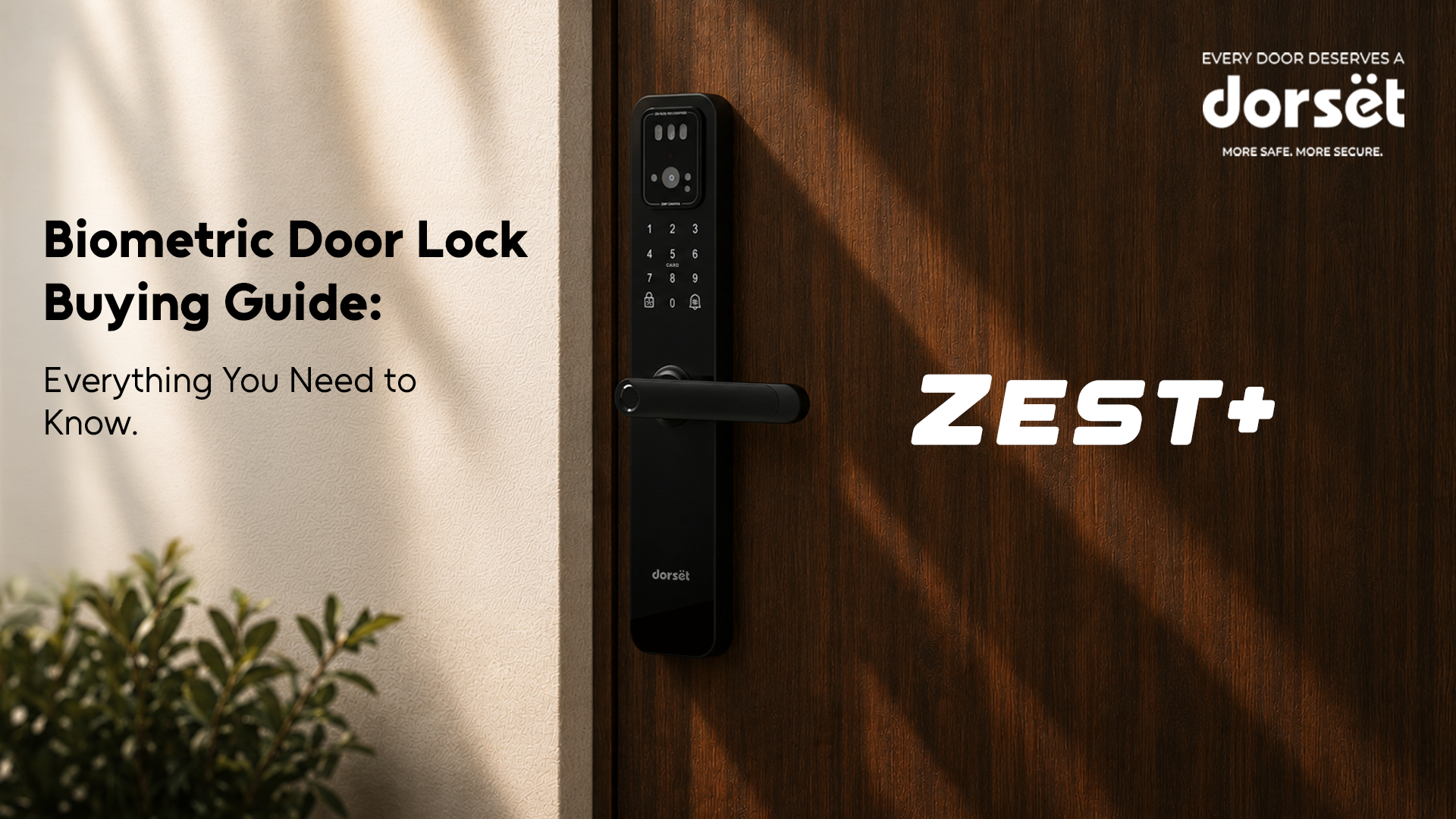
Choosing a door lock today that fits well with your home’s rhythm goes way beyond than just replacing old-school lock and key. Indian homes have busy routines, which is why a biometric door lock can be a practical upgrade for homeowners who want to at least the in and outs simple for everybody.
While innovative digital locks that combine passwords and mobile access are leading the option list, but the right choice, however, should always be based on what kind of door you have along with what the family as whole are collectively comfortable in using.
So, what is a biometric door lock?
A biometric door lock uses a unique feature, such as your fingerprint, to check if you are allowed to enter. Instead of carrying a key, you simply place your finger on the sensor. The lock compares it with the fingerprint stored in its system and unlocks the door if it matches. This makes entry quick, convenient and easier to manage for families with different access needs.
Is fingerprint access enough for your home?
Fingerprint access modes are easy for everybody, but having a smart door lock which has multiple entry options can make the lock more flexible security wise.
Look for features such as:
- 360° fingerprint access
- Password access
- RFID card access
- Mobile access
- Mechanical key backup
- Wi-Fi connectivity
- 2 Li-Poly battery
These choices can suit different family members, while a mechanical key lets you have the peace of mind that no matter what happens, at least you will never sleep outside.
What if you want more than a fingerprint?
That is something many homeowners now want. Well, innovative smart door lock such as ours all come with multi point access that guarantees full control to the homeowners. Dorset DG 202 and DG 402, for example, offer palm vein scan, 360° fingerprint, password, RFID card, and mobile access. DG 402 also supports Wi-Fi and has an automatic roller latch mortise lock. This means, you will never have to worry about anyone dear to you ever getting locked out.
Which biometric feature should you choose?
Fingerprint access is the most common choice for most homes, but biometric locks can offer more options. Like the palm vein scanning and 3D face recognition which allows other ways to identify authorised users.
For example, Dorset’s DG 402 combines palm vein scan with fingerprint, password, RFID and mobile access. DG 406 and DG 206 also add 3D face recognition and video features, offering greater flexibility for homeowners who want advanced access options.
What should you check before buying?
Before selecting a biometric door lock, check your door thickness and think about who will use the lock. Additionally, thinkof the following while making the final choice:
- Consider your family: Choose access options around your family's routine.
- Check connectivity: Check mobile and Wi-Fi support if you need connected functions.
- Keep backup access: Keep mechanical key access as a backup.
Should you choose biometric access or multiple access modes?
The biggest benefit of biometric access is simple: you always have your fingerprint with you - if you're still weighing the decision, read are biometric locks worth the investment for apartments for a detailed breakdown. At the same time, having multiple access options gives your family more flexibility. A working professional can use mobile access, a child easily get in with a face scan, while another family member can choose a password or RFID card. This makes everyday entry easier, especially in homes where everyone follows a different routine.
Which Dorset model suits a feature-rich home?
The four models offer different combinations:
- DG 202: 360° fingerprint, password, RFID card, mobile access, Wi-Fi, mechanical key and VDP integration. It supports 35–90 mm door thickness.
- DG 402: Palm vein scan, 360° fingerprint, password, mobile access, RFID card, Wi-Fi, mechanical key, VDP integration and 2 Li-Poly battery. It supports 35–90 mm doors.
- DG 406: 3D face recognition, palm vein scan, 360° fingerprint, password, mobile access, RFID card, Wi-Fi, mechanical key, integrated video display and VDP integration. It supports 35–100 mm doors.
- DG 206: 3D face recognition, palm vein scan, 360° fingerprint, password, mobile access, RFID card, Wi-Fi, mechanical key, integrated video display and VDP integration. It supports 35–100 mm doors.
So, what is the right choice for your home?
Choosing a Biometric Door Lock starts with understanding your home's needs - our smart digital lock buyer's guide for 2026 can help you compare features across the full range before deciding. If you want straightforward fingerprint access, DG 202 can be a practical choice. If you want more advanced features, DG 402, DG 406 and DG 206 offer additional biometric and video options. Whichever you choose, make sure your Smart Door Lock is compatible with your door and gives your family the access options they need.
FAQ’s
1. What is a biometric door lock?
A biometric door lock uses unique physical features, such as fingerprints, to verify a person's identity before granting access. It removes the need for traditional keys and offers a quick, convenient, and secure way to enter your home.
2. What should I check before buying a biometric door lock?
Look for reliable fingerprint recognition, strong construction, multiple access options, battery backup, emergency unlocking, and easy installation. Choosing a trusted brand like Dorset can also ensure better product quality, support, and long-term performance.
3. Are biometric door locks suitable for Indian homes?
Yes. Biometric door locks are well-suited to modern Indian homes because they offer keyless access and can support multiple users. They are especially convenient for families where several people regularly use the main entrance.
4. What happens if the fingerprint scanner doesn't work?
Most quality biometric locks have multiple access methods such as PIN codes, RFID cards, mobile apps, or mechanical keys. Dorset smart locks offer multiple access options on selected models, ensuring you have a backup when fingerprint access isn't available.
5. How secure are biometric door locks?
Biometric locks offer an additional layer of security by using unique physical identifiers for access. Premium models can also include features such as dual authentication, intrusion alerts, OTP access, and strong physical construction for more comprehensive door protection.