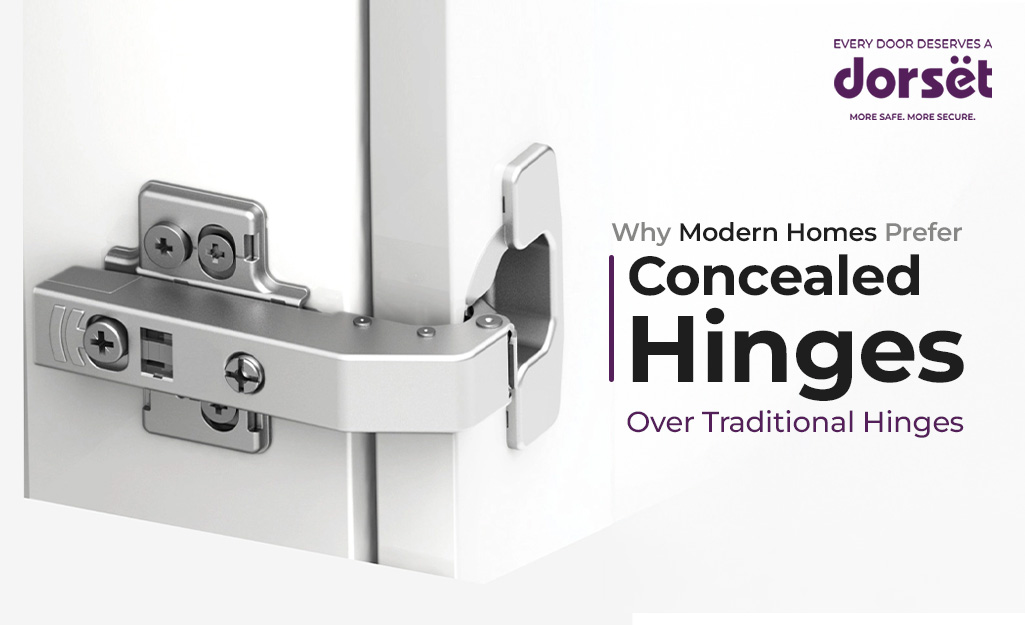
Good design is often about what you don’t see. It is about clean lines, uninterrupted surfaces, and details that quietly do their job without demanding attention. In modern homes, doors are something more than a functional item for partition. They are part of the architecture, the flow, and the visual feel of a space. That is why concealed hinges have become something transformative. By hiding the mechanics completely, they allow doors to sit perfectly flush with walls, frames, and panels, creating a seamless, refined look.
Architects and homeowners are choosing concealed hinges not as an upgrade, but as a natural extension of modern design thinking where elegance, precision, and performance work together without being seen.
The Shift Toward Cleaner, Minimalist Design
Modern architecture is all about simplicity. Flush surfaces, straight lines, uninterrupted planes, and calm interiors define today’s design language. Traditional butt hinges, ball bearing hinges, or flush hinges do work perfectly well but they often break this visual flow because they remain visible even when the door is closed.
Concealed hinges solve this problem completely. Since the hinge body is hidden within the door and frame, the door sits perfectly flush when closed. There’s nothing to distract the eye. The door becomes part of the wall rather than a separate visual element.
This is why concealed hinges are now preferred for:
- Luxury homes
- High-end apartments
- Designer villas
- Minimalist interior projects
With concealed hinges, design feels intentional rather than assembled.
Performance Matters as Much as Appearance
While the visual appeal is obvious, concealed hinges are not just about looks. They offer a serious upgrade in performance compared to traditional hinges.
Concealed hinge systems, like the TECTUS range by Simonswerk that we bring to India, are engineered for precision. These hinges support heavy doors with ease while maintaining smooth, silent movement over years of daily use.
Unlike traditional door hinges that can sag, squeak, or lose alignment over time, concealed hinges are designed to stay stable. Many models support load capacities ranging from 60 kg all the way up to 300 kg, making them suitable for everything from internal wooden doors to heavy-duty entrance doors.
Comfortable 3D Adjustment Makes Life Easier
One of the biggest practical advantages of concealed hinges is 3D adjustability. Traditional hinges often require door removal or repeated adjustments if alignment shifts. That can be frustrating for both installers and homeowners.
With concealed hinges, adjustments can be made:
- Sideways
- Vertically
- In compression
This allows perfect door alignment even after installation. Minor building movement, changes in temperature, or material expansion no longer mean struggling doors. The hinge adapts instead of forcing the door out of line.
For architects and project managers, this means fewer callbacks. For homeowners, it means doors that continue to function smoothly for years.
Maintenance-Free and Built for Longevity
Another reason concealed hinges are gaining preference is low maintenance. High-quality concealed hinge systems use maintenance-free slide bearings instead of traditional friction points.
This results in:
- No lubrication requirements
- No squeaking over time
- Consistent opening and closing motion
- Long operational life
Once installed correctly, they simply work quietly in the background.
Designed for Design Freedom
Modern homes are no longer limited to standard door formats. Designers are experimenting with:
- Extra-tall doors
- Wide door leaves
- Heavy materials
- Glass doors
- Cladded door surfaces
- Recessed frames
Concealed hinges enable all of this.
The TECTUS hinge systems offer multiple variants that allow architects to design freely without compromising on performance:
- TECTUS models support different load capacities up to 300 kg
- TECTUS Glass allows flush installation of glass doors without glass machining
- TECTUS FVZ enables invisible frames for recessed installations
- TECTUS A8 supports door and frame cladding up to 8 mm
- TECTUS FR integrates fire safety with an intumescent kit
- TECTUS Energy provides permanent energy transfer for smart locks, access control, or powered doors
Each variant is designed to maintain a uniform appearance and closed hinge body, keeping the visual language consistent across spaces.
Better Safety and Smarter Integration
Safety is another area where concealed hinges excel. Fire-rated concealed hinge models include integrated intumescent materials that expand during a fire, helping prevent the spread of smoke and flames between spaces.
In smart homes, concealed hinges also play an important role. With systems like TECTUS Energy, power can be transferred directly through the hinge, eliminating exposed wiring. This supports smart locks, access control systems, and powered door hardware while preserving a flush design.
This makes concealed hinges ideal for:
- Smart homes
- High-security entrances
- Commercial buildings
- Offices with access control systems
Ideal for Modern Materials and Finishes
Modern homes use a wide range of finishes and materials. From timber and steel to aluminium and glass, concealed hinges are designed to work seamlessly across them all.
They also come in a variety of finishes that can be matched or intentionally contrasted with door hardware. Whether the goal is to completely hide the hinge or highlight it subtly, designers have flexibility.
Because the hinge disappears when the door is closed, it allows other elements like handles, locks, and wall finishes to take centre stage.
Why Architects and Designers Prefer Concealed Hinges
From our experience working with architects across India, the preference for concealed hinges comes down to a few clear reasons:
- They support minimalist design goals
- They improve door performance and longevity
- They allow precision installation and easy adjustment
- They support heavier and more complex door designs
- They integrate well with smart and fire-rated systems
Simply put, concealed hinges make doors feel engineered rather than assembled.
Concealed Hinges in India, Available Through Dorset
While concealed hinge technology is globally advanced, access to the right systems matters. At Dorset, we make the Simonswerk TECTUS concealed hinge systems available in India, so that designers and homeowners can access world-class hinge technology with local availability and support.
By combining German engineering with Dorset’s understanding of Indian doors, materials, and site conditions, we help make sure concealed hinges perform exactly as intended in real-world applications.
Final Thoughts
Concealed hinges align perfectly with how people want to live today. Clean spaces, quiet function, long-lasting performance, and doors that feel effortless. As architecture continues to evolve toward simplicity and precision, concealed hinges are no longer a luxury. They’re becoming the standard.
At Dorset, we believe good design should feel invisible yet work flawlessly. That’s exactly what concealed hinges deliver.
FAQ
1. What are concealed hinges and how are they different from traditional hinges?
Concealed hinges are hidden within the door and frame, making them invisible when the door is closed. Unlike traditional hinges, they allow flush doors, cleaner lines, and better alignment without visible hardware interrupting the design.
2. Are concealed hinges strong enough for heavy doors?
Yes. High-quality concealed hinge systems like the TECTUS range support door weights from 60 kg up to 300 kg. They are engineered for heavy wooden, metal, and even entrance doors without compromising smooth movement or stability.
3. Do concealed hinges work for main doors or only internal doors?
Concealed hinges are suitable for both internal and main doors, depending on the load capacity selected. Heavy-duty variants are designed specifically for entrance doors, busy areas, and large-format door leaves.
4. Are concealed hinges adjustable after installation?
Yes. One of the biggest advantages is 3D adjustability. Concealed hinges allow precise side, height, and compression adjustments even after installation, helping maintain perfect door alignment over time.
5. Do concealed hinges work with different door materials?
Concealed hinges are compatible with timber, steel, aluminium, and glass doors. They are designed to adapt to modern construction materials while maintaining strength, alignment, and smooth operation.