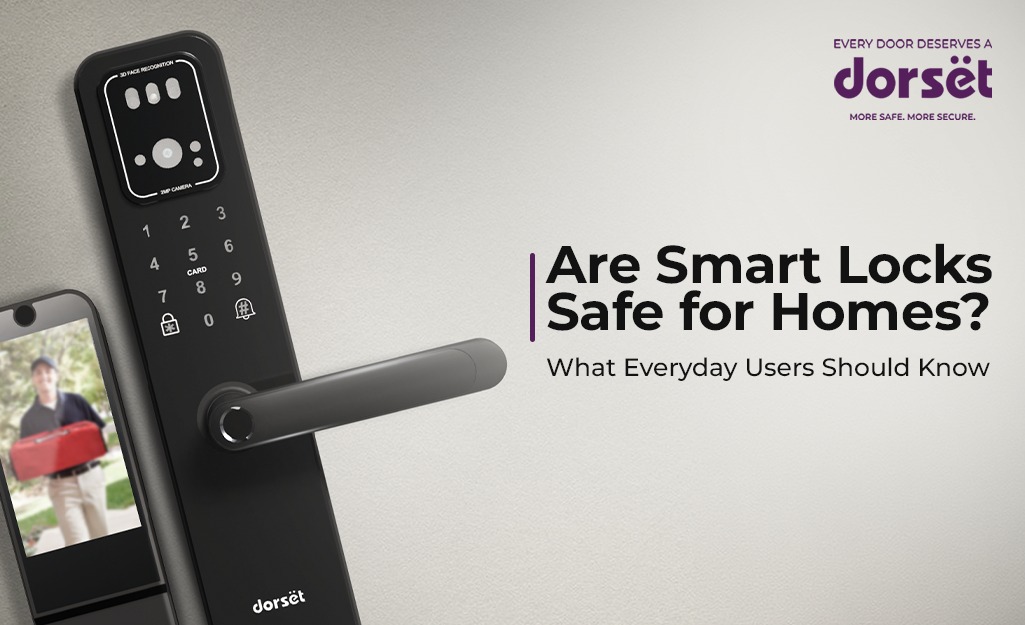
If you have ever thought about upgrading your home lock, this question has probably crossed your mind in a very real and practical way while considering safety for your family and home.
Are smart locks actually safe?
The short answer is yes. But like most modern technology, their safety depends on how you use them.
When used properly, smart locks can actually make your home more secure than traditional locks because they reduce common break-in risks and give you better control while keeping you informed about what is happening at your door.
Understanding How Smart Locks Work
Before forming an opinion about their safety, it is important to understand how smart locks function in everyday situations and how they replace the limitations of traditional keys with modern digital access methods.
Smart locks replace traditional keys with digital access methods like:
- PIN codes
- Biometrics like fingerprint, face recognition, palm vein scan, etc.
- Mobile apps
- RFID cards
Instead of depending on one metal key, you now have multiple secure ways to unlock your door which gives you the assurance that your access is never dependent on a single point of failure.
For example, with models like the Dorset DG 406, we offer 3D face recognition, fingerprint access, PIN entry, and mobile unlocking so that even if one method is unavailable, you always have backup options.
This flexibility itself adds a layer of safety that traditional locks simply cannot provide.
Why Smart Locks Can Be Safer Than Traditional Locks
A smart home lock is designed to address many of the vulnerabilities that exist in mechanical locking systems, making it a more advanced and responsive solution for everyday home security challenges faced by modern households.
Harder to Break Into
Traditional locks can be vulnerable to several common intrusion techniques that are widely known and frequently used by intruders in residential settings.
Traditional locks can be picked, bumped, and the keys duplicated.
Smart locks remove many of these risks by replacing physical dependency with digital authentication methods that are significantly more difficult to manipulate.
With no exposed keyhole in many designs, lock picking becomes extremely difficult while digital authentication replaces physical duplication.
For instance, in the Dorset DG 203 PRO, access happens through fingerprint, PIN, RFID, or your mobile which means there is no easy physical entry point for common tampering methods.
You Control Who Enters Your Home
Managing access to your home becomes far easier and safer when you no longer rely on physical keys that can be misplaced, duplicated, or circulated without your knowledge.
Think about how many spare keys exist for your current door.
- House help
- Former tenants
- Guests
- Neighbours
You cannot track where those keys go which creates a long-term security concern that often goes unnoticed.
Smart locks solve this by allowing you to digitally manage entry permissions with complete flexibility.
You can:
- Create temporary PINs for guests
- Remove access anytime
- Assign unique entry modes
If someone no longer needs access, you simply delete it without needing to replace the entire lock.
You Stay Informed
Another major advantage of smart locks lies in the awareness they provide by keeping you connected to your door activity even when you are not physically present at home.
With video-enabled locks like DG 206, you can even see who is at the door before allowing entry which adds another layer of security and surety before you open the door.
Addressing Common Concerns
Despite the many advantages offered by smart locks, it is completely natural for homeowners to have doubts and questions about reliability, safety, and everyday usability.
Let’s address the most common ones.
Can Smart Locks Be Hacked?
Security concerns around hacking often arise because of misunderstandings about how digital protection works in real-world smart lock systems.
In reality, the best smart locks for home use encrypted systems that make sure that communication between your phone and lock remains protected.
Also, hacking is not as simple as movies make it seem and usually requires:
- Close physical proximity
- Specialised tools
- Time
Regular software updates also keep improving security and help protect against evolving threats.
When we design models like the Dorset DG 904 with palm vein and fingerprint authentication, the access data is stored securely and cannot be easily duplicated.
What Happens During Power Failure?
Many people assume that smart locks depend entirely on electricity, but in reality they are designed to operate independently using battery-powered systems.
Smart locks are battery powered, not electricity dependent. So even during power cuts, they continue to function without interruption.
Most locks also:
- Alert you about low battery
- Offer mechanical key backup
So you are never locked out even in unexpected situations.
What If My RFID Card Is Lost?
Losing your RFID card can seem like a major concern, but smart locks are designed with multiple backup options to prevent access issues.
If you lose your RFID card:
- You still have fingerprint access
- You still have PIN access
- You still have mobile access or mechanical backup
Compare this to losing a physical key which usually means changing the entire lock.
Are Smart Locks Perfect?
While smart locks provide significant benefits, it is important to understand that no security system is completely perfect or maintenance-free.
Smart locks require:
- Battery checks
- Occasional software updates
- Stable connectivity for full remote features
But these are small responsibilities compared to the benefits they provide.
It is similar to maintaining your smartphone where a little upkeep ensures long-term performance.
Smart Locks vs Traditional Locks
Comparing both systems clearly highlights the additional advantages that smart locks bring into everyday home security.
Traditional locks offer:
- One access method
- No tracking
- No alerts
Smart locks offer:
- Multiple access modes
- Real-time awareness
- Controlled permissions
With options like the Dorset DG 204 PRO, you also get the option to integrate it with video door systems to add an extra layer of entry verification.
The Bottom Line
Smart locks can be very safe for homes when used correctly and integrated thoughtfully into your daily routine.
In many ways, they reduce the risk that comes with common break-in methods in mechanical locks while giving you better control and visibility.
But like any smart device, the effectiveness depends on:
- Choosing quality products
- Using features wisely
- Keeping systems updated
If you adopt simple habits, smart locks can make your home not just more convenient, but more secure too.
FAQ
1. Are smart locks really safe for homes?
Yes, smart locks can be very safe when installed correctly because they use multiple authentication methods and digital security layers that are harder to bypass than traditional key locks. Dorset smart locks combine multiple access modes like fingerprint, PIN, mobile access, and more for layered security.
2. Can smart locks be hacked easily?
No, most quality smart locks use encrypted communication and secure authentication systems, making hacking extremely difficult without close physical access and specialised tools.
3. What happens if the smart lock battery dies?
Most smart locks warn you well in advance when the battery is low and still allow backup access methods like mechanical keys or external power options. Dorset smart locks provide low battery alerts and have a backup mechanical key access for uninterrupted entry.
4. Are smart locks difficult for everyday users?
No, most smart locks are designed for simple daily use and operate just like unlocking a smartphone with fingerprint or a code. Dorset digital locks are designed for easy operation with simple digital access.
5. Can smart locks improve home security?
Yes, they improve security by reducing risks like key duplication and allowing controlled access for family members or guests.